In the bustling markets of Nairobi and the rural homesteads of the Rift Valley, one culinary duo defines Kenyan mealtime—ugali, the dense maize porridge, served alongside rich, flavorful stews. More than just sustenance, this pairing represents the soul of Kenyan hospitality, where simplicity meets depth, and communal dining becomes an act of connection.
Ugali’s neutral, comforting presence provides the perfect canvas for the vibrant, often fiery stews that accompany it, creating a balance that has nourished generations. Whether enjoyed in a city eatery or under the shade of an acacia tree, this combination tells the story of Kenya’s agricultural roots, cultural diversity, and unwavering love for hearty, satisfying food.
The Making of Ugali: Simplicity as an Art Form
Ugali’s magic lies in its minimalist preparation—white maize flour (or sometimes millet or sorghum) stirred vigorously into boiling water until it thickens into a smooth, dough-like consistency. The process seems straightforward, but mastering it requires intuition. Too much water, and the ugali becomes mushy; too little, and it turns crumbly. A wooden mwiko (stirring stick) is the traditional tool, its broad, flat surface ideal for working the mixture into a cohesive mass. The final product should hold its shape when molded, yet remain soft enough to tear easily with the fingers—Kenya’s preferred utensil for scooping up stew.
The Stew Spectrum: From Sukuma Wiki to Nyama Choma
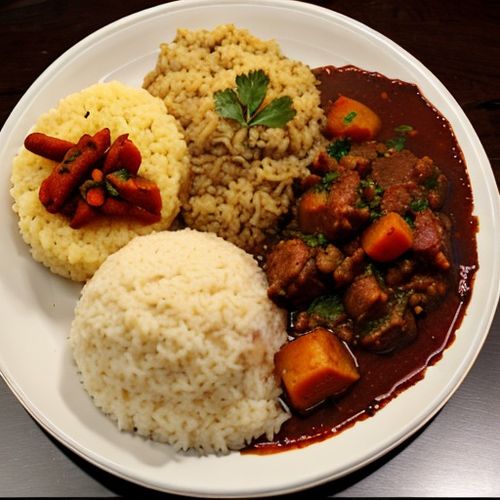
While ugali is constant, the stews it accompanies vary widely, reflecting Kenya’s regional and cultural diversity. Sukuma wiki (collard greens simmered with tomatoes and onions) offers a vegetarian option, its slight bitterness contrasting beautifully with ugali’s mildness. Nyama choma (grilled goat or beef) often comes with a side of kachumbari (tomato and onion salsa) for brightness. In coastal regions, coconut-infused fish stews bring a touch of Swahili influence, while githeri (a hearty mix of beans and maize) provides rustic, protein-rich comfort. Each stew, whether meat-based or plant-forward, is designed to complement ugali’s texture and temper its neutrality with bold, slow-cooked flavors.
The Perfect Bite: Technique and Tradition
Eating ugali and stew is an interactive experience. A small piece of ugali is pinched off, rolled into a ball, and then indented with the thumb to form a edible scoop. This makeshift utensil is then dipped into the stew, collecting just the right amount of sauce and ingredients. The skill lies in shaping the ugali so it holds together without falling apart—a technique Kenyan children learn early. The contrast between the soft, slightly sticky ugali and the saucy, often spicy stew creates a dynamic mouthfeel that keeps each bite interesting.
Nutritional Harmony: A Balanced Plate
Beyond flavor, this pairing is a nutritional powerhouse. Ugali, made from whole maize flour, provides complex carbohydrates and fiber, offering sustained energy—a necessity in Kenya’s active agrarian lifestyle. The stews, rich in proteins (from meat, beans, or dairy) and vitamins (from leafy greens or tomatoes), ensure a well-rounded meal. The combination is naturally gluten-free and adaptable to various dietary needs, making it a staple not just by tradition but by practical necessity.
Cultural Significance: More Than Just Food
Ugali and stew transcend mere nutrition—they are woven into Kenya’s social fabric. The act of sharing a communal pot fosters unity, whether in family gatherings or casual meetings with friends. Special occasions call for elaborate stews, like mutura (blood sausage) or mursik (fermented milk-mixed ugali in Kalenjin culture), while everyday meals keep it simple. The dish’s affordability and accessibility make it a great equalizer, enjoyed by everyone from Nairobi executives to Maasai herders.
Modern Twists: Ugali in Contemporary Cuisine
While tradition reigns, innovation is creeping in. Upscale Nairobi restaurants now serve ugali fries—crispy, sliced ugali wedges—as appetizers. Fusion versions incorporate ingredients like spinach or beetroot for colorful variations. Yet, even with these creative spins, the essence remains: ugali’s role as the ultimate comfort food, steadfast and adaptable.
To eat ugali and stew is to experience Kenya’s culinary heartbeat—a harmony of simplicity and depth, tradition and adaptability. The dish’s humble ingredients tell a story of resilience, while its preparation and sharing reflect the warmth of Kenyan hospitality. In a world of fleeting food trends, ugali and stew endure, proving that the most satisfying meals are often the simplest. Whether enjoyed in a bustling city kibanda (eatery) or a quiet village home, each bite is a reminder that food, at its best, is both nourishment and connection.
By David Anderson/Mar 29, 2025

By Sophia Lewis/Mar 29, 2025
.jfif)
By Emily Johnson/Mar 29, 2025
By Lily Simpson/Mar 29, 2025
By Emily Johnson/Mar 29, 2025

By Natalie Campbell/Mar 29, 2025
By Thomas Roberts/Mar 29, 2025
By Olivia Reed/Mar 29, 2025
By Daniel Scott/Mar 29, 2025
By William Miller/Mar 29, 2025
By George Bailey/Mar 29, 2025

By William Miller/Mar 29, 2025
By Amanda Phillips/Mar 29, 2025
By Christopher Harris/Mar 29, 2025
By Megan Clark/Mar 29, 2025
By Sarah Davis/Mar 29, 2025
By Samuel Cooper/Mar 29, 2025
By Victoria Gonzalez/Mar 29, 2025

By Olivia Reed/Mar 29, 2025