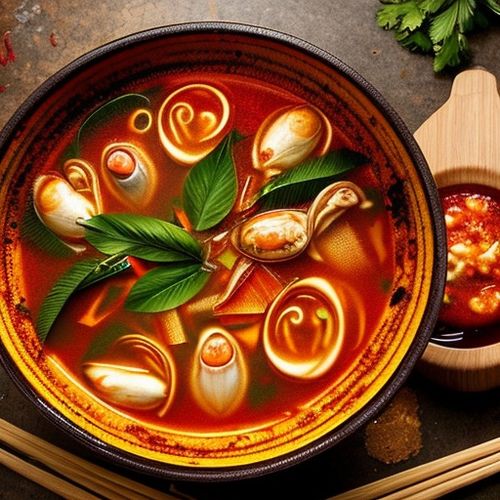
In the steamy kitchens of Bangkok's street food stalls and high-end restaurants alike, a single dish captures the essence of Thai culinary philosophy—tom yum goong, the iconic hot and sour soup that dances on the palate like a perfectly choreographed ballet.
This deceptively simple broth, infused with the perfume of lemongrass and kaffir lime leaves, the heat of bird's eye chilies, and the tang of tamarind, represents centuries of refined balance. More than just soup, tom yum embodies the Thai concept of rot chart—the ideal harmony of flavors where no single element dominates, but each plays its part in creating something greater than the sum of its parts.
The Foundation: Building Layers of Flavor
Authentic tom yum begins with a clear, aromatic broth that whispers rather than shouts. Freshwater prawns or chicken bones simmer gently with lemongrass stalks bruised to release their citrusy oils, galangal sliced thin to diffuse its piney warmth, and kaffir lime leaves torn just before adding to preserve their floral intensity. This trio—known as krueang khua—forms the holy trinity of Thai soups, their essential oils infusing the liquid with complexity that forms the canvas for other flavors. Unlike Western stocks that rely on long cooking, tom yum broth achieves depth quickly, its freshness being as vital as its richness.
The Heat Equation: Chili as Conductor
Thai bird's eye chilies (prik kee noo) bring more than just fire—their fruity brightness acts as both flavor and sensation. The art lies not in sheer quantity but in timing; whole chilies added early impart subtle warmth, while finely chopped additions at the end deliver immediate punch. True masters adjust heat levels like audio engineers—balancing frequencies so the chili's voice rings clear without drowning out other notes. This nuanced approach to spice reflects Thailand's sophisticated heat culture, where burn serves as a flavor enhancer rather than a macho challenge.
Sour Alchemy: The Citrus Spectrum
Tom yum's signature tang comes from a carefully calibrated blend of acidic ingredients, each contributing distinct personality. Tamarind paste lends fruity depth, lime juice provides bracing freshness, and sometimes a splash of nam som (fermented pineapple) adds funky complexity. The sour elements are added in stages—some during cooking to meld flavors, others just before serving for vibrant top notes. This multilayered acidity creates the soup's "bright" quality that awakens rather than overwhelms the palate, demonstrating how Thai cuisine elevates sour from mere taste to emotional experience.
The Umami Undercurrent
What separates great tom yum from good is its hidden depth—the savory foundation that keeps the fireworks grounded. Fish sauce (nam pla) added drop by drop builds salinity without fishiness, while quick-cooked seafood (traditionally river prawns) contributes natural sweetness. Some versions add a touch of roasted chili paste (nam prik pao) for smoky richness, or straw mushrooms for earthy contrast. These umami elements work subtly, ensuring the soup satisfies as much as it excites, a reminder that even the most vibrant flavors need anchoring.
Texture as Flavor
Tom yum engages the mouth with more than taste—its contrasting textures form part of its magic. Crisp-tender vegetables like mushrooms or baby corn provide resistance against the broth's silkiness. Prawns should be just cooked to retain snap, while fresh herbs like cilantro and sawtooth coriander add leafy crunch. Even the temperature plays a role—served scalding hot to intensify aromas, yet cooling slightly as diners navigate through layers of ingredients. This tactile dimension transforms eating from passive consumption to active exploration.
Regional Variations: A Nation's Personality
Across Thailand, tom yum adapts to local character without losing its soul. Chiang Mai versions might include nam prik noom (green chili relish) for herbal freshness, while southern cooks add turmeric and coconut milk for creamier heat. Bangkok street vendors often serve tom yum nam khon—a slightly thickened iteration with evaporated milk—while Isaan variations lean heavier on lime and herbs. These differences don't represent deviations from some "authentic" standard, but rather showcase Thailand's regional diversity within a shared culinary language.
The Ritual of Serving
Presentation matters as much as preparation. Traditional clay pots (maw gleung) retain heat while adding earthy aroma, their wide mouths allowing steam to carry the soup's perfume upward. Accompaniments like extra lime wedges, chili flakes, and fish sauce empower diners to fine-tune balance—an interactive element rare in Western cuisine. The act of ladling soup becomes ceremony, with careful attention to distributing ingredients evenly, ensuring each spoonful tells the complete story.
Modern Interpretations and Global Love
From Manhattan bistros to London gastropubs, chefs worldwide attempt tom yum interpretations—some successful (tom yum-infused risottos), others questionable (tom yum pizza). Thailand itself sees avant-garde versions using molecular techniques or premium ingredients like lobster. Yet the soul remains unchanged; when flavors harmonize correctly, the dish transcends trends. UNESCO's recognition of Thai cuisine as intangible cultural heritage has spurred renewed interest in traditional preparations, ensuring tom yum's essence survives its global popularity.
To sip proper tom yum is to understand Thai culture—its boldness tempered by refinement, its complexity arising from simple truths. That first spoonful that makes your eyes widen (from chili), then crinkle (from sour), then close in contentment (from balance) offers more than nourishment—it's a masterclass in equilibrium. In our polarized world, tom yum stands as delicious proof that opposites don't just attract; they can create perfection when balanced with wisdom and care. Whether enjoyed at a plastic table by the Chao Phraya River or recreated at home with patience, this iconic soup remains Thailand's gift to global gastronomy—a reminder that true greatness lies not in extremity, but in harmony.
By David Anderson/Mar 29, 2025
By Sophia Lewis/Mar 29, 2025
.jfif)
By Emily Johnson/Mar 29, 2025
By Lily Simpson/Mar 29, 2025
By Emily Johnson/Mar 29, 2025
By Natalie Campbell/Mar 29, 2025
By Thomas Roberts/Mar 29, 2025
By Olivia Reed/Mar 29, 2025
By Daniel Scott/Mar 29, 2025
By William Miller/Mar 29, 2025
By George Bailey/Mar 29, 2025

By William Miller/Mar 29, 2025
By Amanda Phillips/Mar 29, 2025
By Christopher Harris/Mar 29, 2025
By Megan Clark/Mar 29, 2025
By Sarah Davis/Mar 29, 2025
By Samuel Cooper/Mar 29, 2025
By Victoria Gonzalez/Mar 29, 2025
By Olivia Reed/Mar 29, 2025